
When a day on Lake Ontario turns into a legal maze
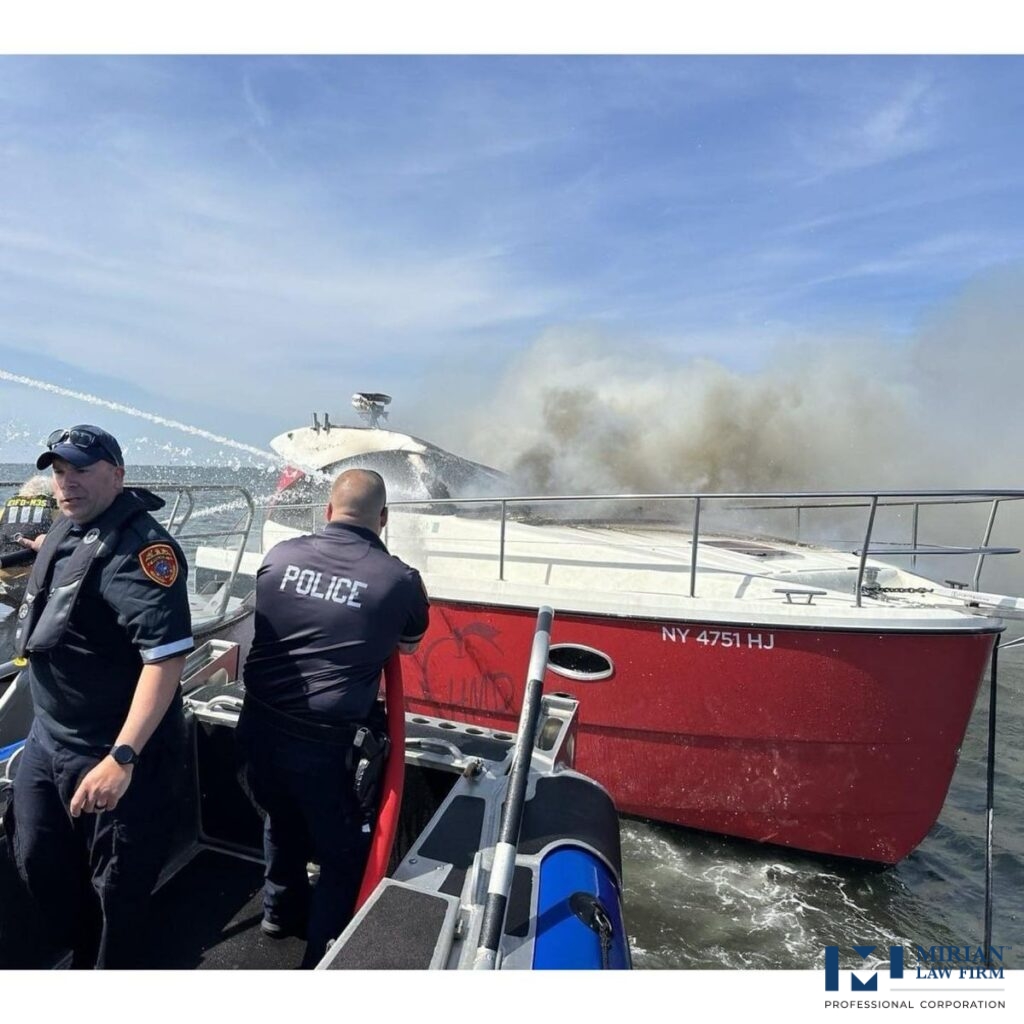
Table of Contents
Dusk settles off the Toronto Islands as two boats clip bows near Humber Bay. Fiberglass cracks, someone screams, fuel hangs in the air. Sirens rise; blue lights from the Toronto Police marine unit sweep the water while injured passengers clutch rails. In that chaos, you’re already thinking: under Ontario law, who pays your hospital bills, your lost income next week, and the repairs to your boat?
One operator says you cut across; the other blames a sudden wake. Phones buzz, an insurer pushes for a recorded statement, and you’re cold, shaken, and hurt. Right now the only question that matters is who pays under Ontario law—and how you prove it. We’ll show you the roadmap in minutes. Free consultation, no fee unless we win. Need help now? Call 647-556-5888 and we’ll start preserving evidence tonight.
Ontario rules that shape boating liability
So which rules create those patterns? In plain English: the Canada Shipping Act (federal navigation and collision reporting rules) and its Collision Regulations set right-of-way, lookout, and safe speed. The Small Vessel Regulations require safety gear and operator competency. The Criminal Code covers impaired operation. Ontario’s Negligence Act (contributory fault law) allocates percentages. The OPP Marine Unit (Ontario Provincial Police) and Toronto Police Marine Unit respond; their incident reports, diagrams, and witness notes often become key exhibits in your civil claim.
On the water, operators must check required equipment, keep a constant lookout, travel at a safe speed, and display proper lighting at night. Compliance helps; violations hurt. For example, missing navigation lights or no horn can suggest negligence. We collect manuals, pre-departure checklists, maintenance logs, and photos/video, then preserve originals. Chain of custody means we document who captured each file, when, and on which device, so insurers can’t argue the evidence was altered.
Criminal or administrative steps run alongside civil injury claims. Statements, roadside-style breath tests, and provincial offence tickets aren’t the whole case, but they intersect with negligence analysis. Timelines matter: police investigations may take weeks; insurer notice can be due within days; civil limitation is generally two years. We coordinate communications so you don’t give harmful recorded statements, and we sync your claim with any charges or hearings.
Cite common local settings where rules are tested—busy fairways off the Toronto Islands, Scarborough Bluffs swell, Port Credit and Pickering marinas, and nighttime traffic near Harbourfront—to reinforce Ontario relevance.
For tailored guidance, talk to a personal injury lawyer in Toronto ; we’ll explain your duties and next steps in minutes.
Why “who is at fault” is rarely simple on the water
Picture a rental pontoon crossing the Centre Island ferry lane while its operator misjudges distance. A wakeboarding run in Humber Bay ends when an aggressive turn slings a rider into a piling. Near Whitby, a sudden steering failure sends a bow off course. Off Cherry Beach at night, two boats dispute right of way. Wind, chop, vessel speed, and shared lookout duties all move the needle.
You hear horns, see masthead lights vanish, feel that sickening jolt. Was the operator speeding, or did the rental company skimp on a safety briefing? Could the owner, marina, or manufacturer share blame? Under Ontario contributory negligence, percentages matter, and defendants multiply fast. Without quick action, witnesses disperse, GPS tracks (navigation logs) overwrite, and marina CCTV (security cameras) loops in 7–14 days. That’s how clear proof slips away.
Call a personal injury attorney
early so we can preserve data, canvas marinas, and identify every liable party.
Here are the recurring factors that make Lake Ontario fault decisions tricky—and why we move fast to secure proof.
- Shared fault under the Ontario Negligence Act makes each party’s percentage matter for recovery.
- Unknown or hit-and-run operators on open water require fast witness canvassing and marina outreach.
- Night operations reduce sightlines; lighting and lookout rules become crucial evidence points.
- No dashcams—so GPS/chartplotter data, AIS (where applicable), and phone metadata fill the gap.
- Insurance layers vary (owner vs. operator vs. rental/commercial policies), affecting recovery paths.
The costly mistakes people make after a crash
Set up a succinct, actionable list of the most damaging post-incident mistakes we see across Toronto, Durham, Peel, and Niagara shores.
Mistake 1: Apologizing or accepting blame at the dock or on-scene—often misread and used against you.
Mistake 2: Failing to call authorities or file a report—Ontario reporting duties can be pivotal evidence.
Mistake 3: Skipping immediate medical assessment—gaps in care undercut causation and damages.
Mistake 4: Repairing or disposing of the boat before inspection—spoliation risks and lost defect proof.
Mistake 5: Not collecting witness and marina contact details—people vanish once boats leave slips.
Mistake 6: Posting on social media—photos and captions can be taken out of context by insurers.
Mistake 7: Ignoring policy notice deadlines—late notice can jeopardize coverage opportunities.
Use our personal injury resources
hub for checklists and timelines so you don’t miss critical steps after a boating crash.
Who can be liable: parties, duties, and proof in Ontario
You’ve seen our checklists—now here’s the matrix we use in Ontario claims. It maps negligence elements—duty, breach, causation, damages—to Lake Ontario scenarios, showing who’s responsible and which evidence wins. Next, we turn it into a step-by-step investigation plan.
| Potentially Liable Party | Ontario Duty/Standard | Common Breach Examples | Key Evidence to Prove | Notes (Ontario nuance) |
|---|---|---|---|---|
| Boat operator (person at the helm) | Keep proper lookout, safe speed, obey Collision Regulations; stay sober under Criminal Code. | Speeding near shore, impaired operation, failing right‑of‑way, no lights at night, reckless wake. | Police/marine unit reports, GPS or chartplotter tracks, phone photos/videos, VHF (marine radio) audio, witness statements. | Fault split under Ontario Negligence Act; damages reduced by your percentage of blame. |
| Boat owner (entrustment/maintenance) | Reasonably maintain vessel; entrust only to competent, sober operator with valid PCOC (Pleasure Craft Operator Card). | Lending to unlicensed, impaired, or inexperienced operator; ignoring known defects; missing safety gear. | Ownership records, insurance policy, PCOC status (Pleasure Craft Operator Card), maintenance logs, prior complaints. | Owner may be liable even off‑boat; insurance layering can cover both owner and operator. |
| Rental or charter company (livery) | Provide seaworthy craft, required safety gear, competent briefing, and basic checks of sobriety and competency. | Poor maintenance, missing PFDs (personal flotation devices), no safety talk, overpowered craft, letting minors operate. | Rental agreement, waiver, pre‑departure checklist, service records, staff schedules, marina CCTV (security cameras). | Waivers are scrutinized; unclear or overbroad terms and gross negligence won’t bar claims. |
| Tour operator or commercial carrier | Elevated duty to paying passengers; follow SOPs (standard operating procedures) and Transport Canada rules. | Overloading, unsafe route in weather, inadequate crew or supervision, ignoring forecasts. | Passenger manifests, training and certifications, voyage logs, weather data, radio calls. | Commercial standards weigh heavily; internal manuals often define negligence in practice. |
| Manufacturer or distributor | Design, manufacture, and warn of hazards; meet standards. | Defective steering or throttle, fuel system failures, inadequate warnings, unstable hull design. | Expert inspections, download data, recalls, service bulletins, prior similar incidents. | Ontario product liability allows negligence and warranty theories; spoliation risk if parts discarded. |
| Maintenance or repair shop; marina service | Perform competent repairs and inspections; warn of hazards noted. | Faulty repair, missing recall, failing to secure fittings, skipping sea‑trial. | Work orders, parts invoices, technician notes, emails, dock logs, CCTV. | Marina footage and gate logs can place boats and staff at key times. |
| Event organizer (race, regatta, demo) | Plan and control reasonably; safety boats, course design, briefings, permits. | Poor course design, missing safety boats, inadequate marshals, unclear instructions. | Permits, risk assessments, safety plans, marshal statements, radio traffic. | Duties scale with control over participants and venue; contracts matter. |
| Government or authority (Transport Canada/municipality) | Maintain navigational aids and public facilities with reasonable care; warn of hazards. | Missing or dark buoys, unmarked hazards, unsafe docks or ramps. | Service logs, Notices to Mariners, maintenance contracts, prior complaints, 311 records. | Short notice and special procedures may apply; get legal advice immediately. |
How we uncover fault on Lake Ontario: an investigation playbook
Set up a sequential, practical process from day 1 through expert analysis; emphasize coordination with OPP/Toronto Marine Units and local marinas.
- Step 1: Secure the scene and medical care; call 911 and request marine responders.
- Step 2: Preserve the vessel and components; prevent repairs until inspected by experts.
- Step 3: Capture data—GPS/chartplotter, engine ECM logs, VHF call records, phone metadata.
- Step 4: Obtain police/marine reports and witness statements; canvas nearby marinas and docks.
- Step 5: Photograph lighting, markers, and weather/wave conditions; obtain Environment Canada data.
- Step 6: Verify operator status—PCOC, sobriety, training; collect rental/briefing documents.
- Step 7: Map insurance layers (owner, operator, rental/commercial) and notify carriers timely.
- Step 8: Engage qualified experts (accident reconstruction, human factors, mechanical) for causation.
Real Ontario scenarios: how liability played out
Once those experts get to work, you see it in real cases. At Hanlan’s Point after dark, two runabouts disputed right-of-way; shared lookout failures led to split liability and a coordinated resolution. Near Centre Island, a rented Sea-Doo rider hit a moored boat; no safety briefing and poor screening put responsibility on the operator and rental company. Off Ajax, sudden steering loss on a bowrider pointed to a defective helm and missed service bulletin, shifting focus to supplier and service.
That Hanlan’s Point crash unfolded on a moonless night with ferry traffic nearby and patchy cabin lights. The Centre Island rental happened on a sunny Saturday with heavy weekend chop and paddlecraft crowding the channel. The Ajax failure occurred at dusk after a wind shift, light rain beginning, and moderate swells pushing the bow off line. Those conditions mattered; they changed safe speed, lookout demands, and whether a prudent operator should have postponed, rerouted, or slowed.
For Hanlan’s Point, the chartplotter GPS (satellite location) track and phone metadata pinned speed and headings; Toronto Police Marine Unit notes and night-mode photos proved lighting gaps. For Centre Island, the rental contract, missing briefing checklist, and marina CCTV (security cameras) synced with timestamps and bar receipts. For Ajax, helm teardown photos, service orders, and a manufacturer bulletin tied the steering defect to missed maintenance. When the data lined up, disputes narrowed and cases resolved, and the focus shifted to compensation.
If a crash is fatal, our wrongful death lawyers in Toronto
team helps your family navigate claims, deadlines, and investigations with care.
What compensation can Ontario boat crash victims claim?
After those scenarios—including fatal crashes—your next question is money: what’s recoverable? In Ontario boating cases, amounts turn on evidence quality and fault apportionment, so here are the main categories we build and document from day one.
- Medical and rehabilitation: acute care, physiotherapy, occupational therapy, and future care plans.
- Income loss and earning capacity: time off work and long-term vocational impacts.
- Pain and suffering: within Ontario principles; severity and duration drive assessment.
- Housekeeping and attendant care: support for functional limitations at home.
- Out-of-pocket expenses: prescriptions, travel to treatment, specialized equipment.
- Family Law Act claims: support for close family members impacted by the injuries.
Trauma after a collision is real; our psychological injury lawyers in Toronto team handles PTSD (post‑traumatic stress disorder), anxiety, and depression claims—then we’ll show you next steps to protect access and your case.
What to do after a boating accident on Lake Ontario
Frame this as a calm, step-by-step guide tailored for Toronto and Ontario waters.
- Step 1: Get to safety and render aid; wear PFDs and avoid secondary collisions.
- Step 2: Call 911 and request Marine Unit; follow directions from responders.
- Step 3: Exchange information (names, vessel numbers, insurance) and photograph IDs/registrations.
- Step 4: Document scene—boats, damage points, markers, lighting, wave/wind.
- Step 5: Identify witnesses and get phone/email; ask marinas for CCTV retention.
- Step 6: Seek same-day medical assessment; report all symptoms, even mild.
- Step 7: Preserve the vessel and components; do not authorize repairs yet.
- Step 8: Notify insurers promptly; note claim numbers and adjuster contacts.
- Step 9: Keep a recovery journal—pain levels, missed work, expenses, appointments.
- Step 10: Consult an Ontario injury lawyer early to coordinate experts and next steps.
If your crash also involved a vehicle near ramps or parking areas, our car accident lawyers in Toronto
can coordinate claims and insurers.
Common defenses—and how to counter them
And if your crash also involved a vehicle near a ramp, expect familiar defenses. We counter them with GPS tracks, marina CCTV, and forecast logs—Ontario proof that narrows or defeats blame.
- Contributory negligence: Use precise speed, lookout, and lighting evidence to narrow fault percentages.
- Assumption of risk/waivers: Emphasize limits—cannot waive gross negligence; scrutinize briefing quality.
- No lifejacket: Tie causation to actual mechanism of injury and other safety failures.
- Weather/waves: Show foreseeability via forecasts, logs, and prudent-route alternatives.
- Unknown wake: Establish operator behavior and proximity; identify source via CCTV/marina logs.
- Late claim: Argue discovery rules and diligence; show early steps taken to preserve evidence.
If injuries are life‑altering, our catastrophic injury lawyers in Toronto
coordinate medical experts, future care reports, and trial strategy. Next, here’s how our Mirian approach puts that playbook to work for you.
How Mirian Law Firm builds winning boating claims in Ontario
So how do we put that playbook to work for you? Day one, we preserve evidence, coordinate with OPP (Ontario Provincial Police) and the Toronto Police Marine Unit, and retain reconstruction and mechanical experts within 48 hours. We line up medical access, document injuries, and shield you from insurer calls. Our bilingual team explains each step, then we press for fair settlement—or litigate. Free consultation, and you pay nothing unless we win under our contingency fee model.
Speed matters, so you’ll hear from us weekly at first, then bi‑weekly as filings move. You’ll know costs up front: contingency percentage, disbursements, and when they apply—no surprises. We’re trial‑ready from day one with timelines, exhibits, and experts. Local knowledge helps too: Harbourfront, Centre Island, Bluffer’s Park, Port Credit—plus spring floods, summer chop, and fall squalls. That’s how we choose routes, challenge defenses, and build visuals juries understand.
- No-win, no-fee: Risk-free representation so you can focus on recovery.
- Local insight: Familiar with Toronto harbour routes, marinas, and seasonal conditions.
- Medical network: Connect you to rehab providers and specialists promptly.
- Investigation muscle: Access to reconstruction and mechanical experts for boats.
- Clear communication: Regular updates and multilingual support for Ontario families.
As a full-service Ontario personal injury law firm
we pair boating expertise with proven results across disability and serious injury claims. Have questions? Our Ontario FAQs below answer the ones we hear most.
Ontario FAQs about Lake Ontario boating liability
You had questions—we promised answers. Below are concise, Ontario‑specific responses you can use today. If your situation is unusual, call us and we’ll tailor next steps.
- Do I have to report a boating accident in Ontario?: Yes—if there’s injury, death, a missing person, or major damage. Call 911, notify the police marine unit, and complete any required written report.
- What if alcohol was involved?: Impaired operation can trigger Criminal Code charges. In civil claims, it’s evidence of negligence and may justify punitive damages, boosting settlement leverage.
- Can a boat owner be liable if not present?: Yes. Owners can be liable for negligent entrustment (lending to unlicensed or impaired operators) and negligent maintenance (unsafe craft). Owner insurance may respond even if another person operated.
- What if the other boat left the scene?: Call police, collect witness contacts, and request marina CCTV. We canvas docks and social media to identify vessel and insurer.
- How long do I have to start a claim?: Generally two years in Ontario. Claims against governments may have shorter notice. Act to preserve evidence and meet deadlines.
Free Ontario case review—speak to a lawyer today
Evidence fades and deadlines move fast—let’s preserve both now. Call 647-556-5888 for a free, confidential consultation. We work on contingency: no fee unless we win. We know Lake Ontario’s corridors—Toronto Islands, Scarborough Bluffs, Port Credit, Pickering—and we can start preservation letters today to protect your claim.
Prefer a call-back? Request your free consultation and we’ll contact you today. Your conversation is confidential, and our no-win, no-fee model keeps costs off your plate. From the Toronto Islands to Pickering, we move fast—CCTV loops in days and GPS logs overwrite—so we act now to secure proof.